Before It's Gone: The Everyday New Jerseyans Racing to Save Their Communities' Creative Histories
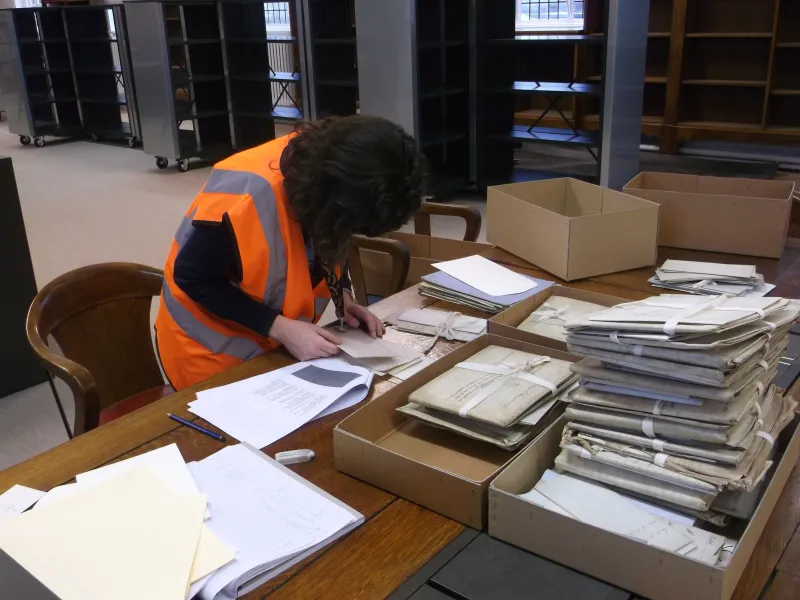
Photo: community archivist sorting old photographs and documents in small office, via citymakinghistory.org
There's a cardboard box in a Bloomfield apartment that might be the most important archive in New Jersey. Inside it: photocopied set lists, a water-stained notebook filled with chord progressions, cassette tapes with handwritten labels, and about 200 photographs of a Newark jazz scene that most people under 40 have never heard of. The woman who keeps that box—a retired music teacher named Gloria Watkins—isn't a historian by training. She's just someone who refused to let the past disappear.
"Nobody was coming to do it," she says, matter-of-factly. "So I did it myself."
Across New Jersey, a quiet but urgent movement is taking shape. Everyday people—artists, community organizers, librarians moonlighting as filmmakers, teenagers with smartphones and TikTok accounts—are stepping into the role of cultural preservationist. Not because they were hired to. Because they understand something that a lot of official institutions seem to keep forgetting: if you don't document your own story, someone else will tell it wrong. Or worse, no one will tell it at all.
The Gaps That Institutions Leave Behind
New Jersey has no shortage of cultural institutions. Newark has the Newark Museum of Art. Asbury Park has a robust historic preservation society. Montclair has galleries. But ask any grassroots archivist in the state where the real gaps are, and they'll give you the same answer almost immediately: the unofficial stuff. The scenes. The subcultures. The immigrant art communities that never made it into a press release. The basement shows that shaped entire generations of musicians but never got reviewed in a newspaper.
"Institutions tend to document what already has prestige," says Marcus Delgado, a Rutgers-trained archivist who left a university job to start his own independent documentation project in Camden. "They wait until something is already recognized as important before they start preserving it. But by then, a lot of the texture is already gone. The people who were there have moved away, or passed on, or just forgotten the details."
Delgado's project, which he runs out of a shared workspace in Camden's Lanning Square neighborhood, focuses specifically on the city's punk and hardcore underground—a scene that thrived in the late 1980s and 1990s and produced bands that influenced musicians up and down the East Coast, but that has almost no formal documentation to speak of. He's been collecting zines, interviewing former scene members, and digitizing old VHS footage that people recorded on camcorders at shows. It's painstaking, underfunded work. He does most of it on nights and weekends.
"Camden doesn't have the cultural cachet of Asbury Park," he says. "So nobody came here to document what was happening. We have to do it ourselves."
Oral History as Resistance
In Newark, a different kind of archival work is happening—one rooted in conversation rather than physical artifacts. The Ironbound Oral History Collective, a volunteer-run group founded in 2019, has been recording interviews with longtime residents of the neighborhood, with a particular focus on the immigrant artists who have shaped its creative landscape over the past four decades. The Ironbound is home to one of the largest Portuguese-speaking communities in the United States, and its arts scene—visual art, music, dance, community theater—reflects that heritage in ways that rarely get acknowledged outside the neighborhood itself.
"There's a whole world happening here that people drive right past on their way to somewhere else," says Fatima Rodrigues, one of the collective's co-founders. "We started recording these stories because we realized that the people who lived them weren't going to be around forever. And we didn't want to lose them."
The collective now has over 150 recorded interviews, many of them with artists who have never been profiled in any publication. They're working with a local web developer to build an online archive that will make the recordings publicly accessible—though funding, as always, is the sticking point.
"We've applied for grants," Rodrigues says with a tired laugh. "It's a process. Meanwhile, we just keep recording."
The Digital Generation Steps Up
Not all of New Jersey's grassroots archivists are working with old-school methods. In Paterson, a 24-year-old named Devonte Simms has been documenting the city's hip-hop scene almost entirely through social media—Instagram posts, YouTube mini-documentaries, and a podcast that he records in his car because it's the quietest place he can find. His platform, which he calls Silk City Archives (a nod to Paterson's historic nickname), has built a following of several thousand people who tune in specifically to hear stories about local artists, producers, and MCs who shaped the region's sound.
"Paterson has a deep hip-hop history that people from outside don't know about," Simms says. "I grew up hearing about it, and I thought—why isn't this documented? Why isn't anyone talking about this?"
So he started talking about it himself. What began as a hobby has turned into something closer to a vocation. Local artists reach out to him regularly, wanting to share their stories. Older heads from the scene have started trusting him with photographs and recordings they've kept private for years. He's become, almost by accident, a community historian.
"The digital tools make it easier in some ways," he acknowledges. "But the hard part is still the same as it's always been. You have to earn people's trust. You have to show up consistently. You have to care."
Why It Matters More Than Ever
The urgency behind all of this work isn't hard to understand. New Jersey is changing fast. Gentrification is reshaping neighborhoods that were once the incubators of entire artistic movements. Longtime community spaces are closing. The people who were present at the creation of scenes that mattered—jazz, punk, hip-hop, immigrant folk traditions—are getting older. The window for capturing their memories is narrowing.
And there's something else, too. In an era when cultural narratives are increasingly shaped by algorithms and platform economics, the stories that don't generate clicks tend to disappear. Grassroots archivists are, in a real sense, pushing back against that tendency—insisting that the full complexity of a community's creative life deserves to be remembered, not just the parts that went viral.
"History isn't just the stuff that gets famous," Gloria Watkins says, glancing toward her cardboard box. "Most of the best stuff never got famous. That doesn't mean it didn't matter."
She's right. And somewhere in New Jersey tonight, someone else is recording an interview, scanning a flyer, or uploading a blurry photograph to a website that twelve people follow—making sure that when the next generation comes looking, there's something left to find.