Rust, Reinvention, and Raw Creativity: Why NJ's Old Factory Towns Are the East Coast's Hottest Art Scene
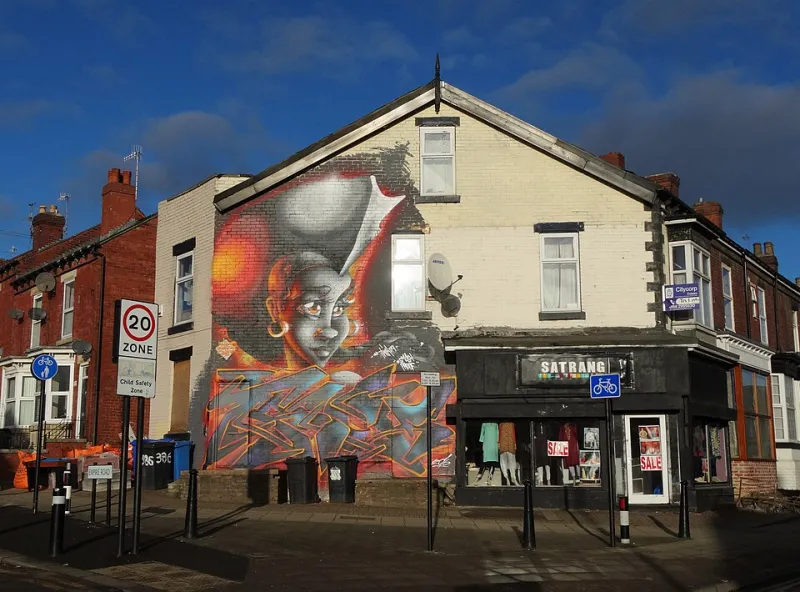
Photo: Neil Theasby , CC BY-SA 2.0, via Wikimedia Commons
There's a particular kind of light that filters through the tall, dusty windows of a converted warehouse. It's the kind of light that makes you feel like something important is about to happen. If you've wandered through Newark's Ironbound district lately, or stumbled into one of Jersey City's Journal Square studio collectives on a Saturday afternoon, you already know exactly what we're talking about. New Jersey's post-industrial cities — long dismissed as pass-through zones between Manhattan and everywhere else — are quietly, confidently becoming one of the most dynamic art ecosystems on the East Coast.
And the artists who are building this thing? They're not transplants chasing a trend. Many of them grew up here.
Newark: The City That Refused to Be a Footnote
Let's start where the energy is loudest. Newark has been on the cultural radar for a while now — NJPAC anchors the downtown arts scene with world-class programming, and the Newark Museum of Art holds its own against institutions twice its size. But the more interesting story is happening in the gaps between the marquee venues.
Take the Hahne & Co. building on Broad Street, which has evolved into a mixed-use cultural hub anchoring a neighborhood that once felt forgotten. Or walk through the Ironbound on any given weekend and you'll find murals that rival anything in Philadelphia's Mural Arts Program — vivid, politically charged, community-commissioned work that treats blank walls as public conversation starters rather than eyesores.
Artist and Newark native Sonia Reyes — whose large-scale textile installations have shown at spaces in New York and Philadelphia — recently moved her primary studio back to the city after a decade away. "I can afford to make big work here," she says plainly. "In Brooklyn, I was making small work because I had a small space. Here, I have a 2,000-square-foot studio and I'm paying less than I was for a closet in Bushwick." The economics aren't subtle, and they're driving a genuine migration of serious makers back to New Jersey.
Jersey City: The Borough That Brooklyn Forgot to Annex
Jersey City has been flirting with its art-district identity for years, but something has crystallized recently. The Grove Street and Journal Square corridors have developed a density of gallery spaces, artist-run project rooms, and experimental venues that feels less like a scene in formation and more like one that's already arrived.
The White Eagle Hall on Newark Avenue — a beautifully restored 1910 hall that hosts everything from indie concerts to immersive theater — is emblematic of how the city approaches cultural space: honor the bones of the building, make it functional, keep it accessible. Meanwhile, smaller operations like the Mana Contemporary complex in the Powerhouse Arts District have created a kind of creative campus model, housing artists, galleries, and performance spaces under one roof in a way that encourages genuine cross-pollination.
Local painter and muralist Darius Okonkwo, who grew up in Jersey City's Bergen-Lafayette neighborhood, has become something of an unofficial ambassador for the scene. His work — sweeping portraits of neighborhood elders rendered in vivid acrylic across building facades — has appeared on buildings throughout the city. "People walk past these murals every day," Okonkwo explains. "That's not a gallery audience. That's everybody. That's the whole point."
Paterson: Silk City's Second Act
Paterson doesn't get enough credit. Full stop. The city that once powered America's industrial revolution — it was literally planned by Alexander Hamilton as the nation's first planned industrial city — has a physical landscape that feels almost cinematic in its layered history. The Great Falls, a UNESCO-recognized natural landmark, anchors a downtown that is slowly, deliberately being reclaimed by artists who see the beauty in its complexity.
The Paterson Arts Connection has been doing grassroots work for years, connecting local artists with public spaces and community programming. But newer initiatives are adding momentum. Pop-up gallery events in vacant storefronts along Main Street have drawn crowds that surprised even their organizers. A growing community of Dominican, Guatemalan, and West African artists — reflecting the city's remarkable demographic richness — are producing work that speaks to diasporic identity in ways that feel urgent and specific rather than generically "multicultural."
Photographer and Paterson resident Amara Diallo, whose documentary series on the city's Senegalese community was recently featured in a group show at a Hoboken gallery, sees the moment clearly. "Paterson has always had culture," she says. "What's changing is that people outside Paterson are starting to pay attention."
Why Authenticity Beats Aesthetics Every Time
Here's the thing that gets lost in conversations about arts-driven revitalization: the most compelling creative communities aren't manufactured. They grow from genuine need — affordable space, proximity to community, access to materials and collaborators. New Jersey's post-industrial cities offer all of that in ways that gentrified Brooklyn neighborhoods simply can't anymore.
There's also something to be said for the grit. The tension between a city's industrial past and its creative present produces a particular kind of artistic energy. You see it in work that doesn't prettify struggle, that doesn't sand down the rough edges for a gallery audience that might find them uncomfortable. That honesty is part of what makes the work coming out of Newark, Jersey City, and Paterson feel so alive right now.
The Challenges Are Real — And Worth Naming
None of this is without complication, and good arts journalism doesn't pretend otherwise. Gentrification is a genuine concern in all three cities. As artists move in, rents follow — it's a pattern as old as SoHo. Community advocates in Newark and Jersey City are already raising alarms about longtime residents being priced out of neighborhoods where they've lived for generations.
The artists doing the most thoughtful work in these cities are acutely aware of this tension. Many are actively engaged in anti-displacement efforts, working with community land trusts and advocating for affordable housing policies alongside their studio practices. The goal — and it's an ambitious one — is a creative renaissance that lifts the whole community rather than displacing it.
Come See for Yourself
If you haven't made the trip to explore New Jersey's emerging art cities, consider this your nudge. Check out First Fridays in Newark's arts district, wander through Jersey City's Powerhouse Arts District on a weekend afternoon, or catch one of Paterson's increasingly frequent pop-up art events. Bring your curiosity, leave your preconceptions at the Holland Tunnel, and prepare to be genuinely surprised.
The rust is still there. But so is something new growing through it.