Walls That Speak: New Jersey's Mural Artists Are Turning Concrete Into Community
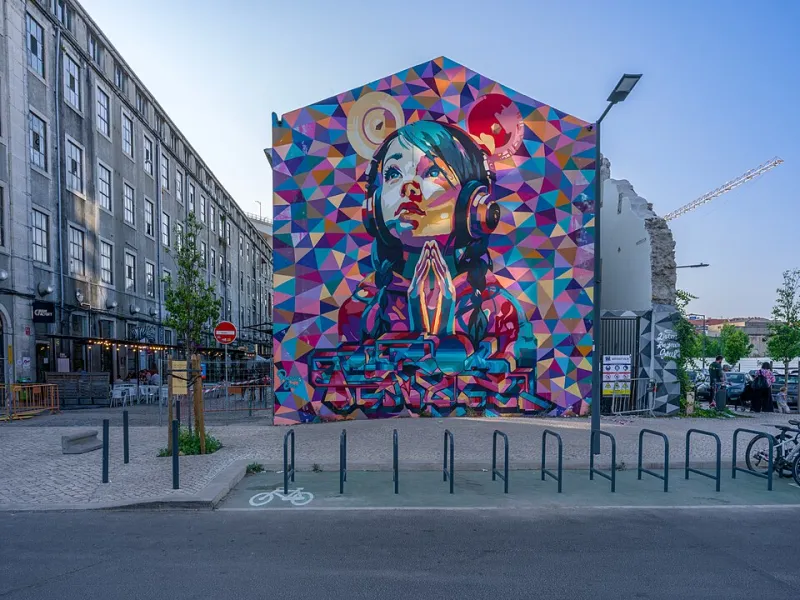
Photo: Dale Cruse - 10M views from San Francisco, CA, USA, CC BY 4.0, via Wikimedia Commons
The Wall Is the Gallery
There's a particular kind of power that comes from art you can't ignore. You don't have to buy a ticket. You don't have to know the right people or navigate a white-cube gallery that makes you feel like you're doing something wrong just by breathing too loud. You just walk past it, and suddenly — there it is. A face the size of a building. A story told in color so vivid it stops traffic.
That's exactly what's happening across New Jersey right now, and it's been building for years. From the sun-bleached streets of Camden to the redeveloping blocks of Asbury Park, muralists are claiming public space with an urgency that feels less like decoration and more like declaration. These aren't just pretty pictures. They're arguments. They're memorials. They're love letters to communities that have spent decades being overlooked.
"When I paint a wall in my neighborhood, I'm not making art for an art world," says Laylo Vasquez, a Newark-based muralist whose work has become a fixture in the Ironbound district. "I'm making it for the woman who walks her kids to school every morning. I'm making it for the old guy who sits on his stoop and remembers what this block used to look like. That's my audience."
Roots in Resistance
New Jersey's mural tradition didn't spring up overnight. It's got deep roots in the same soil as the state's long history of labor organizing, immigrant community building, and neighborhood-level resistance to the kind of top-down urban planning that has, for generations, treated working-class communities as problems to be solved rather than cultures to be celebrated.
Trenton, for instance, has been quietly developing one of the most politically charged mural scenes on the East Coast. Organizations like Trenton Arts at the Mill and a loose network of community muralists have spent years working with residents to create work that reflects local history — including histories that textbooks tend to skip. Murals honoring Black freedom fighters, celebrating Puerto Rican cultural pride, and documenting the labor movements that built this state dot the city's walls in ways that feel genuinely earned, not curated.
"There's a difference between a mural that a city pays for to make a neighborhood look nicer for developers, and a mural that comes from the people who actually live there," explains Marcus Delgado, a community organizer and artist who has facilitated several collaborative mural projects in Trenton. "We try very hard to make sure what we do is the second thing."
The Tension Nobody Talks About
Here's the complicated part, though — and it's worth sitting with for a minute. As New Jersey municipalities have started to recognize the economic and cultural value of public art, there's been a growing push to institutionalize the mural movement. Cities are launching public art programs, offering grants, commissioning work. On one level, that's great. Artists deserve to get paid. Walls deserve to be beautiful.
But some artists are wary. When city hall starts cutting checks, city hall starts having opinions. And those opinions don't always align with the communities the murals are supposed to represent.
"I've seen it happen," says Vasquez. "A neighborhood gets a mural program, and suddenly the designs are going through committees, and the committees want something 'positive' and 'uplifting,' which usually means nothing that makes anyone uncomfortable. And then you've got a mural that looks great in a press release but doesn't actually say anything."
The tension between institutional support and authentic expression is real, and it's not going away. In cities like Jersey City, where rapid gentrification has transformed entire neighborhoods in the span of a decade, the stakes are particularly high. Murals that once served as community landmarks have sometimes been painted over when buildings changed hands. New murals have gone up that reflect the aesthetic preferences of incoming residents rather than the people who built those blocks.
"Public art can be a tool of displacement just as easily as it can be a tool of resistance," notes Dr. Priya Anand, an urban studies researcher at Rutgers who has studied the relationship between public art and gentrification in New Jersey cities. "It depends entirely on who controls the narrative and who benefits from the beautification."
Building Something Real in Asbury Park
Not every story is complicated, though. Down in Asbury Park, a city that has seen its own share of redevelopment drama, a grassroots mural initiative called Shore Lines has been doing something that feels genuinely hopeful. Working with local youth, longtime residents, and artists from across the state, they've created a corridor of murals along Springwood Avenue — a street with enormous historical significance to the city's Black community — that functions as both public art installation and living archive.
The project took years, involved hundreds of community conversations, and produced work that ranges from sweeping historical panoramas to intimate portraits of neighborhood elders. It's been cited as a model for how mural programs can be done with integrity, centering community voice at every stage.
"We spent more time talking than painting," laughs Denise Okafor, one of the project's lead artists. "But that's the point, right? The conversations are part of the work. The wall is just where it ends up."
What Comes Next
The mural movement in New Jersey is at an interesting crossroads. There's more money flowing into public art than ever before. There's more mainstream recognition of street art as a legitimate and valuable cultural form. And there are more artists doing this work — younger, more diverse, technically brilliant, and deeply connected to their communities.
But with visibility comes pressure. Pressure to professionalize, to sanitize, to make work that photographs well for Instagram and doesn't ruffle the wrong feathers. The artists who are doing this work with the most integrity are the ones who are managing to navigate that pressure without losing the thing that made their work matter in the first place.
"I always ask myself: who am I painting for?" says Vasquez. "If the answer is anybody other than the people in this neighborhood, I need to start over."
That question — who is this for? — is the one that separates a mural from a marketing campaign. And in New Jersey right now, the artists who are asking it honestly are creating some of the most vital public art anywhere in the country. You just have to look up from your phone long enough to see it.